
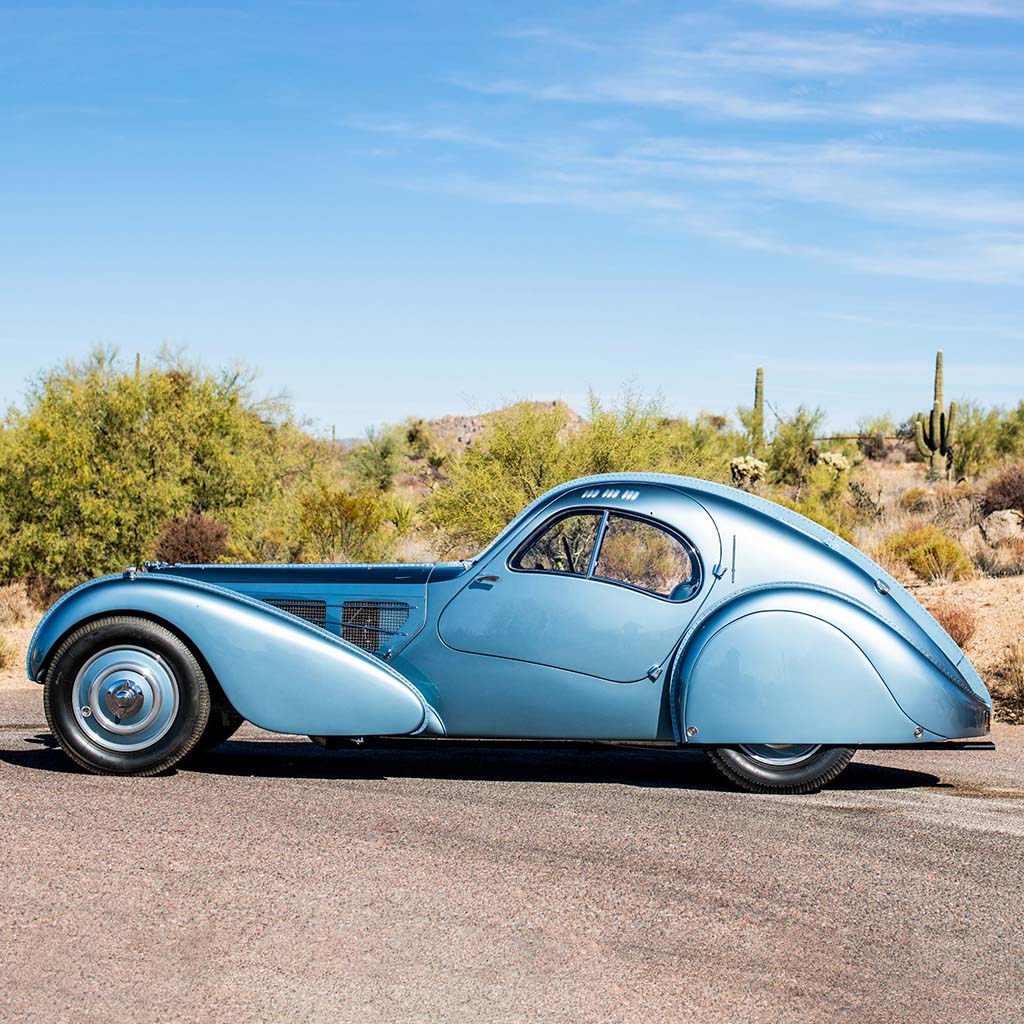
Bugatti Type 57 SC Atlantic
Designed by Jean Bugatti, son of the founder Ettore, the Atlantic was born in 1936 in the Molsheim workshops in Alsace. It descends from a 1935 prototype, the Aérolithe, whose body in Elektron, a magnesium alloy that cannot be welded, had to be riveted together. This technical constraint gave the car its signature: a riveted ridge running from the bonnet to the tail. It was kept as a styling feature on the aluminium models.
“SC” stands for a lowered chassis and a supercharged engine. Its 3.3-litre straight-eight allowed it to approach 200 km/h, an exceptional speed for a road car of the 1930s.
Only four were built, and three still exist. The fourth, nicknamed “La Voiture Noire” (the Black Car), disappeared during the Second World War and its fate remains one of the great mysteries of motoring. Extremely rare and of unrivalled elegance, the Atlantic is today among the most valuable cars in the world.
Why this choice?
Come back soon to discover what comes next, follow our blog.
To follow this project, subscribe now to our two YouTube channels and be notified of new releases:
An opinion, an idea, an insight? Leave us a message
Every new adventure needs a manifesto:
“We declare our wish to be free to explore shapes and lines without limits”